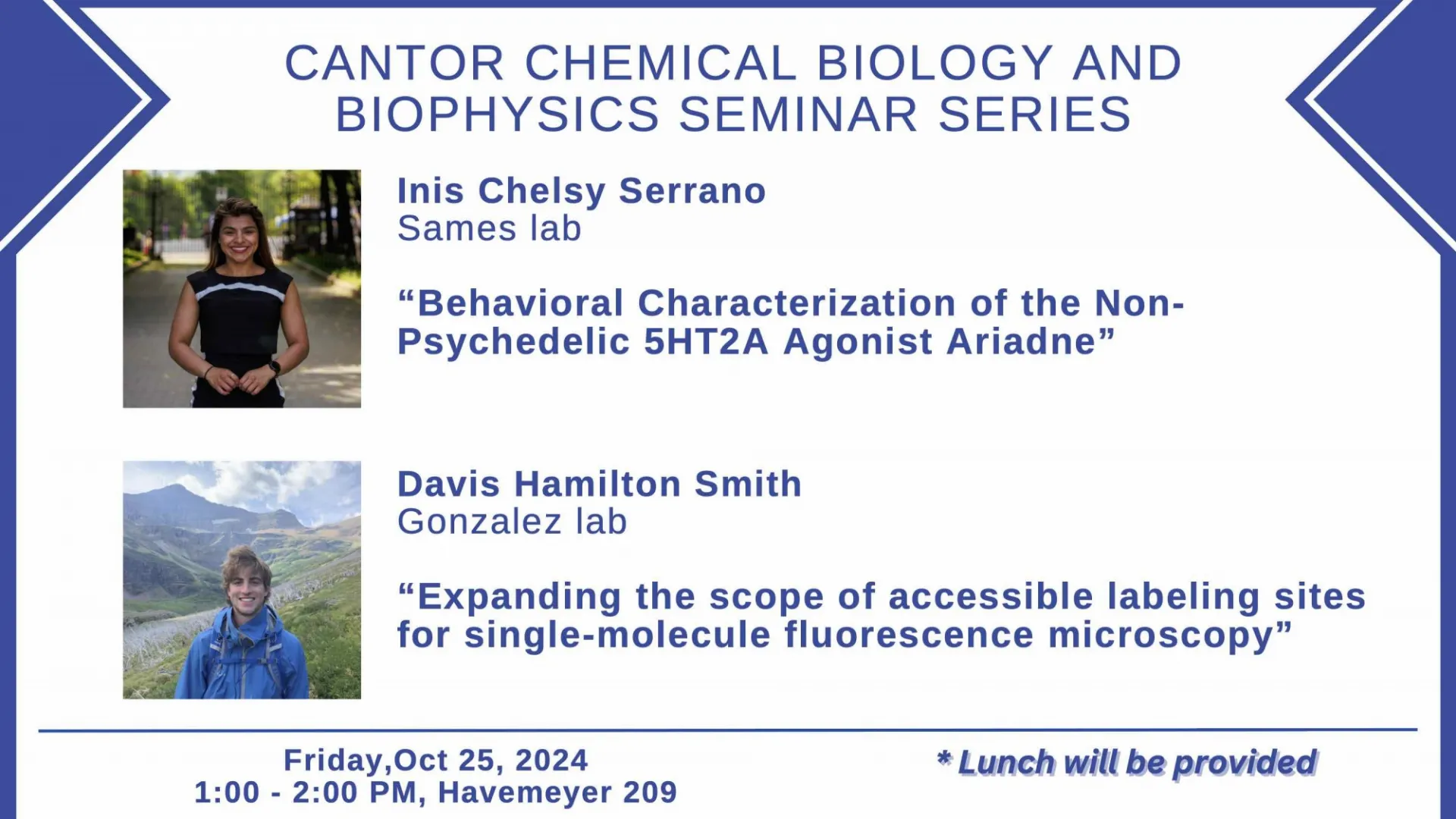
Behavioral Characterization of the Non-Psychedelic 5HT2A Agonist Ariadne
Presented by: Inis Chelsy Serrano
Abstract:
Interest in psychedelics like lysergic acid diethylamide (LSD), psilocybin, and 5- methoxy-N,N-dimethyltryptamine (5-MeO-DMT) is surging due to their potential in treating neuropsychiatric and neurological disorders. Whether the psychedelic experience is essential for therapeutic outcomes and the mechanisms behind serotonergic psychedelics' effects remain elusive. To address this, we conducted behavioral experiments using male C57BL/6J mice, randomly assigned to treatment groups by observers blinded to drug and dose. To investigate the necessity of the psychedelic experience, we explored the therapeutic potential of Ariadne, a non-hallucinogenic serotonin (5-HT) receptor 2A agonist. Despite clinical trials at Bristol-Myers Company suggesting remarkable therapeutic effects without hallucinogenic properties, Ariadne was abandoned as a drug candidate with unknown molecular pharmacology. Compared to a phenethylamine positive control, Ariadne shows markedly attenuated head twitch response (HTR, n = 5/group) – a proxy for psychedelic activity in vivo – as well as lower signaling potency and efficacy in multiple signaling pathways examined (G q/11 ) coupled to 5-HT 2A in vitro. The novelty suppressed feeding paradigm demonstrated Ariadne's anxiolytic-like effects 7 days post-administration (n = 10/group). In a pilot auxilin knockout Parkinson’s Disease (PD) model study (n = 4-6/group), Ariadne acutely rescued severe motor deficits akin to levodopa, suggesting promising therapeutic potential. Our findings propose the lower 5-HT 2A receptor signaling efficacy of Ariadne as an explanatory model for its lack of hallucinogenic effects, which did not diminish its therapeutic effect.
Title: Expanding the scope of accessible labeling sites for single-molecule fluorescence microscopy
Presented by: Davis Hamilton Smith
Abstract:
Advances in fluorescence microscopy have enabled researchers to study life at the single-molecule level, allowing direct observation of compositionally and dynamically heterogeneous systems, such as complex biomolecular machines. However, these experiments require that the biomolecular machine under study be fluorophore-labeled at specific residues that provide insight into uncharacterized mechanistic steps. Unfortunately, fluorophore-labeling essential components of the cellular machinery is labor-intensive and invasive, oftentimes impairing or destroying the function of the labeled biomolecule. As a result, fluorophore-labeling essential components of molecular machines has been a major bottleneck in single-molecule studies. A notable example is single-molecule fluorescence resonance energy transfer (smFRET) studies on the ribosome, a highly conserved biomolecular machine. Here, we demonstrated that we can overcome these limitations and expand the accessible labeling positions on the ribosome. We have developed a novel method where we use a combination of non-canonical amino acid incorporation and competitive cell growth assays to rapidly identify functional and minimally perturbative mutants of essential ribosomal proteins in bacteria. We can then individually purify the functional mutant ribosomes and fluorophore-label them using click chemistry. This method is adaptable to other biomolecular machines, allowing researchers to further unlock the potential of modern microscopy for the mechanistic studies of biological processes.