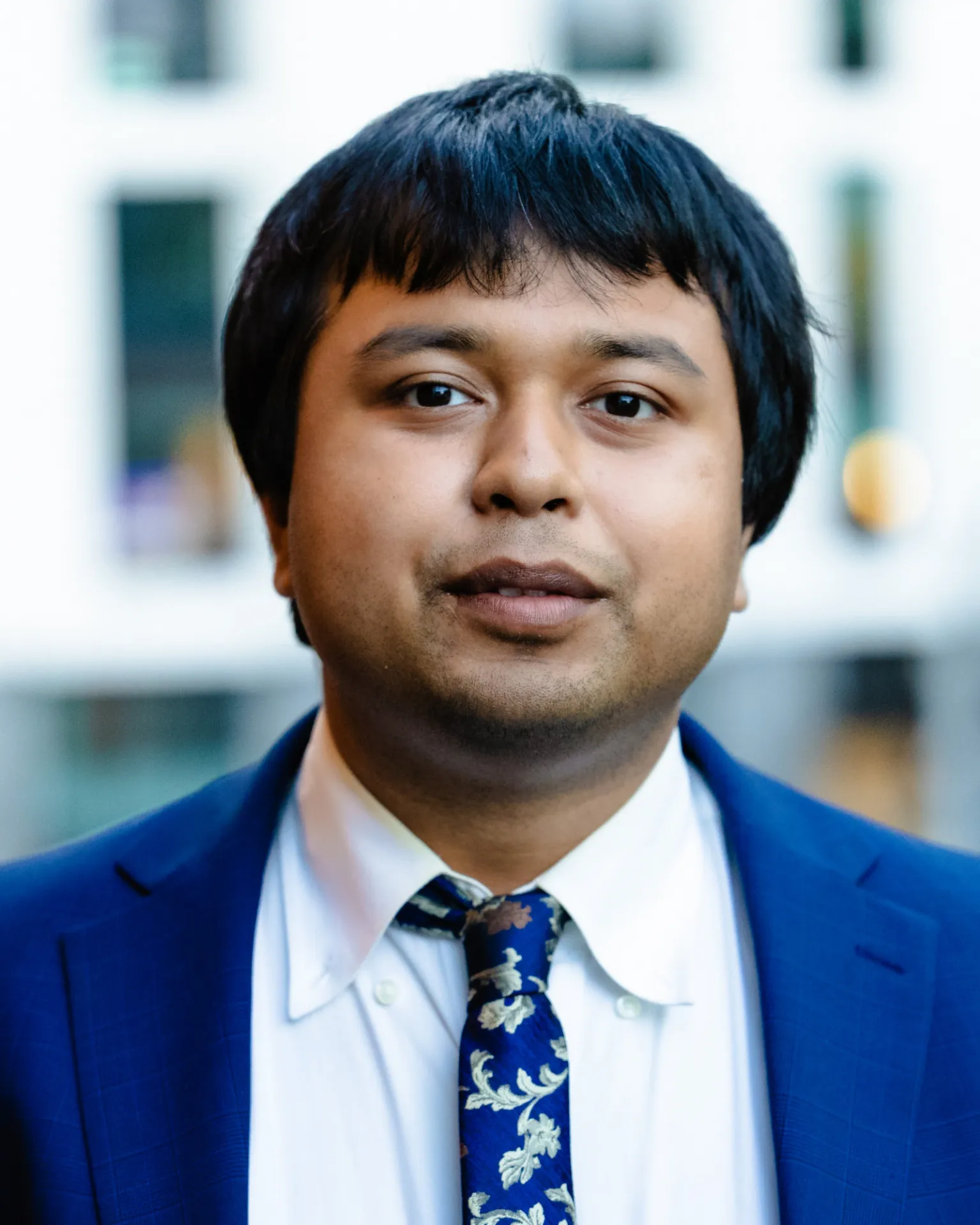
Welcome Professor Diptarka Hait!
The Chemistry Department is pleased to welcome Diptarka Hait to the faculty as Assistant Professor as of July 2025.
Dip is a theoretician who uses quantum mechanics to understand chemical phenomena, particularly those involving light. A childhood fascination with bright colors sparked his interest in chemical physics, leading him to pursue undergraduate studies in chemistry and physics at MIT. There, he was introduced to the wonders of both quantum mechanics and scientific research through his work with Professor Troy Van Voorhis on simulating lighting materials. Dip then pursued graduate studies in chemistry at UC Berkeley, where he worked with Professor Martin Head-Gordon to develop mean-field electronic structure methods. His doctoral work on reliably optimizing molecular orbitals for excited states led to low-cost computational approaches that achieve nearly quantitative accuracy in predicting X-ray spectra. This work enabled extensive collaborations with experimental spectroscopists at UC Berkeley and Lawrence Berkeley National Laboratory to investigate ultrafast processes such as Jahn-Teller symmetry breaking dynamics. Aside from his work on excited states, Dip’s Berkeley research also spanned catalysis, chemical bonding, selected configuration interaction, quantum computing, and combustion. His graduate studies were supported by a Berkeley Fellowship and a Pimentel Research Award. Dip subsequently moved across the San Francisco Bay to be a Stanford Science Fellow hosted by Professor Todd Martinez, studying the coupled motion of electrons and nuclei that drives photochemistry. He has also worked to advance the use of graphics cards for accelerating quantum chemical calculations and for reliably identifying transition states of chemical reactions.
Dip’s scientific contributions have been recognized by several awards, such as a Young Investigator Award from the ACS Division of Physical Chemistry and a CCG Graduate Research Excellence Award from the ACS Division of Computers in Chemistry. Outside of research, Dip held leadership roles in chemistry student organizations at both MIT and UC Berkeley. He also participated in the International Chemistry Olympiads as a high school student, where he won two gold and one silver medals.